Pages

Thursday, February 22, 2018

5 Frustrating Things About Writing


I'm having one of those days where I try to write and the right words just don't come.  Maybe I've got too many writing projects going at once? (I'm working on a novel and a short story at the same time, and I've got my weekly blog post on top of that!)  Anyway, because regular topics just aren't working for me today, here's a post about five frustrating things about writing. 


Plot Bunnies


"Plot bunny" is a term used among writers to mean an idea that distracts you from the thing you're currently writing.  For instance, you're writing medieval fantasy when you get what seems like a really good idea for a story set in 20th century America.  It's really tempting to drop the story you're currently working on and start one based on the new idea.  Don't do it.  Write down the idea and forget about it for now.  If you hop from story to story following plot bunnies, you'll never finish anything. (I need to follow this advice better myself.  I have started countless stories based on plot bunnies, and hardly any of them got beyond five pages.)


Forgetting Details In Your Own Story


 I thought this one just happened to me, but I've heard from a few other people who say the same thing.  You're writing along, and you have to invent a name for a minor character, or the name of a town, or something like that.  You put it in and promptly forget all about it.  When the minor character comes up again three chapters later, you can't remember his name.  So you have to search painstakingly through the first part of your book to find him.  I can only think of two ways to avoid this problem...have a perfect memory or make lists of all the details you might possibly have to remember later.


Plots That Don't Work


You've left your character pining away in a tower from which there is no escape, and now you have no idea how to get him out.  The only option seems to be supernatural aid (or a giant eagle, if you're Tolkien).  And supernatural aid (and eagles) seem unsatisfying, at least to me. You want the characters to be able to solve their own problems without the writer dragging in outside help. 

 I think whoever wrote Brigadoon had this problem.  They left poor Tommy Albright stranded in the modern day with no way to get back to Brigadoon.  The conclusion, where Tommy goes back to the spot where Brigadoon used to be and finds it still there, feels like cheating on the writers' part.  The only explanation for why Brigadoon is still there is "if you love someone deeply enough, anything is possible".  Cute, maybe, but it still feels like a deus ex machina to me.  (This is not to say that I dislike Brigadoon.  On the contrary, it's one of my favorite old movies.)


 Characters That Don't Do What You Want


You know exactly what you want your character to do, but he won't do it.  Instead of being a bold outlaw, he's a wishy-washy outlaw with scruples.  (This example is from a character that appeared in a novel I wrote a few years ago.  He was the main character, and the story didn't work well with him being wishy-washy and scrupulous.)  Anne in Anne of Avonlea complains about the same thing when she's writing her short story, "Averil's Atonement." I have no idea why this happens.  I've heard people saying it's all in the writer's mind.  Maybe it is, and if so, I wish I could figure out what to do about it!  


Distraction


Distracted writing isn't dangerous like distracted driving...but it's still frustrating!  There are an indefinite number of ways to get distracted while you're trying to write.  People in the room, music, the Internet, to-do lists, and just ordinary daydreaming are only a few of the things that make it so difficult to concentrate on the project at hand.  It's impossible to completely eliminate distraction, but you can definitely avoid it.  For me, the best place to work and avoid distractions is a quiet room (with no music, not even instrumental).  I often write my stories longhand on paper, because the computer distracts me too!


Do you relate to any of these frustrating things?  Or have others to add?  I'd love to hear them!


Thursday, February 15, 2018

10 Show-Stealing Movie Sidekicks


While figuring out characters for my current work-in-progress, I've been thinking a lot about the importance of some underrated characters: sidekicks.  They support the main characters or try to show them where they're going wrong.  They're often funny without even trying.  There's also a disarming humility about a lot of sidekicks; they're focused on everyone but themselves. 

After thinking about this for a while, I decided to do a post on it.  (Yes, I'm a college grad and this is the way I choose to spend my free time.  You may judge me.)  Here are ten of my favorite movie sidekicks and supporting characters!  I picked movies because I could show pictures of the characters.  Maybe at some point I'll do a post on sidekicks from books too.


Bartok, Anastasia


Bartok is on the bad side.  He's helping the villain, Rasputin, find the escaped Princess Anastasia.  But Bartok is continually dismayed by Rasputin's evil plans.  He tells him to "forget the girl and get a life!"  Finally he decides it's gone too far: "You're on your own, sir!  This can only end in tears."  Bartok's voice is hilarious (not surprising, since he's voiced by uber-talented Hank Azaria).  This is a sidekick who deserved his own movie...and got it, with Bartok the Magnificent (which is a really fun movie, by the way)!


The Captain of the Guard, Cinderella


The Captain of the Guard in Disney's live-action Cinderella is so great.  He's the best friend Prince Kit seems to have at the palace (besides his father).  When the Grand Duke schemes to bring more power to the kingdom at the expense of Kit's happiness, the Captain is always there to remind everyone that Kit is a person too.  He's also really funny!  I love when Kit is telling him all about the girl he's fallen head over heels for, and the Captain says, "Do you think she has a sister?"  The Captain also gets to put Lady Tremaine in her place at the end.  "Who are you to stop an officer of the king? Are you an empress? A saint? A deity?"


 Kronk, The Emperor's New Groove

 
  Like Bartok, Kronk is the villain's sidekick; Yzma is using him to help her track down the escaped emperor-turned-llama.  (This sounds really weird if you haven't seen the movie.)  Kronk is not the brightest bulb in the box, but when Yzma gets deeply entrenched in ridiculous schemes to kill the emperor, Kronk turns out to be the one who uses common sense!  He's friendly, hilarious, and a great cook.  (In fact, the point where he turns against Yzma is when she tells him she never liked his spinach puffs!)  He also talks to squirrels.


Inigo Montoya, The Princess Bride


I would be remiss if I didn't include one of the most iconic movie sidekicks ever: Inigo Montoya.  Although I don't hold with revenge or dueling, I appreciate the terrific love Inigo has for his father that makes him chase the six-fingered man for so many years.  I also love his interactions with the other characters.  He's incredibly forthright and will tell you just what he's thinking.  

To Vizzini: "You keep using that word.  I do not think it means what you think it means."  

To the Man in Black: "I do not think you would accept my help, since I am only waiting around to kill you!"  

Cogsworth and Lumiere, Beauty and the Beast


I had to mention both of these because they're so hilarious together!  Cogsworth is a mother-hen type and the straight man to Lumiere's funny man.  (Incidentally, my siblings have informed me that he is the Beauty and the Beast character most like me.)  He wants to make sure nobody's breaking rules or making the Beast mad.  Lumiere, on the other hand, thinks that rules are more like guidelines than actual rules.  He wants to show Belle just how hospitable the castle can be!  Their interactions with each other and the Beast are just golden.  

Cogsworth (to the Beast): "Who?  Oh!  The girl. Yes,  the, ah, girl.  Well, actually, she's in the process of, ah, um, circumstances being what they are, ah... she's not coming."

Lumiere (to the Beast): "Master, I could be wrong, but that might not be the best way to win the girl's affections." 


Cosmo, Singin' In the Rain


Cosmo Brown and Don Lockwood started out as good friends who did second-rate vaudeville together.  Then Don Lockwood became a movie star, and Cosmo...well, he played the piano on the set.  All through Singin' In the Rain, while Don's in the spotlight, Cosmo is cheering him up behind the scenes and helping him figure out his problems.  He comes up with terrific ideas, like dubbing Kathy's voice over Lina's in "The Dancing Cavalier."  And he's not looking for fame or recognition, just helping his friends and making people laugh!


Sir Hiss, Disney's Robin Hood


Sir Hiss, evil Prince John's sidekick, always makes me laugh.  On the one hand, he goes around flattering Prince John and even spying for him.  On the other hand, Prince John makes him incredibly crabby...and Sir Hiss is hilarious when he's crabby!  He can see Prince John for what he is: a whiny, cowardly character who's not fit to lead anything, let alone a whole kingdom.  
Prince John: "One more hiss out of you, Hiss, and you are walking to Nottingham"
  Hiss [aside]: "Snakes don't walk, they slither. Hmph. So there."

Hiss: "How nobly King Richard's crown sits on your royal brow."
Prince John [not paying attention]: "Doesn't it?" [realizing, furious] "King Richard?  I told you never to mention my brother's name!" 
Hiss: "A mere slip of the forked tongue, Sire."


 Truman, October Baby


October Baby is a pretty serious movie for the most part.  After all, it deals with a serious theme: the right to life of unborn babies.  But it has some great comedic moments, and a lot of them involve Truman.  

Truman is one of Hannah and Jason's college classmates.  We first see him trying to make a little extra money by "upgrading" people's tickets as they come to a school play.  Next, we see him catching an iron on fire.  No matter what ridiculous thing Truman is doing, he maintains a dignified and gloomy composure that is hilarious in contrast.  And he's nerdy--the kind of socially awkward nerdy that most of us nerds hope we're not.  I love it!


Canoe, That Darn Cat


Canoe is a boy who hangs out at Patti Randall's house, raiding the fridge and taking Patti to surfer movies that make her feel seasick.  But when he suspects that something fishy is going on at the Randall house, he's determined to help Patti out by getting to the bottom of it...and jealous, because he thinks there's a young man involved.  Canoe's bumbling detective attempts are one of the best things about this movie!  
 
Sam Gamgee, Lord of the Rings


Sam Gamgee is an unusual sidekick because he's also the hero of the story!  Sam starts out as Frodo's bumbling, comedic gardener, always needing his master's help and guidance.  But throughout the story, Sam gets wiser and stronger.  As the Ring becomes harder and harder for Frodo to bear, Sam supports him.  He risks his life over and over for Frodo.  Without Sam, the whole quest would have failed.  He's my favorite LOTR character.

These are only a few of my favorite movie sidekicks.  I'd love to see your favorites in the comments!


Thursday, February 8, 2018

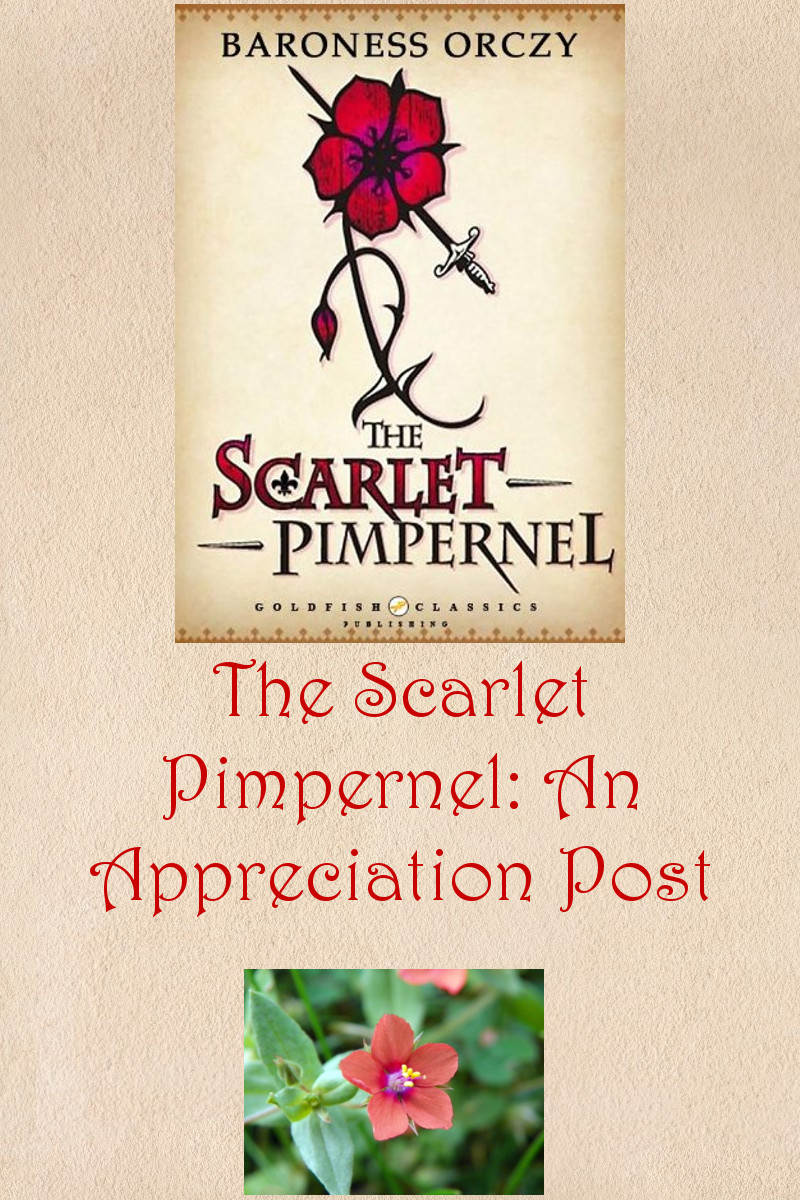
The Scarlet Pimpernel: An Appreciation Post


It's hard for me to describe how much I love this book.  It's one of the few 300+ page books I've read in one sitting.  The characters and the plot are so enthralling I just can't put it down...even after having read it so many times I've lost count!

I told my sister I wanted to do a blog post on The Scarlet Pimpernel, and she said, "Wait...the book or the movie?"  Apparently there are a lot of blog posts out there talking about how great the movie with Anthony Andrews, Jane Seymour, and Ian McKellen is, but very few talking about how great the book is.  So I decided to do a post about the book.  I do like the movie, and maybe sometime I'll do a blog post on that, but the book comes prior.

Where do I start?  I guess I'll start with the characters.

Warning: This post does contain spoilers.  If you haven't read the book, go read it.  Then you can come back and read this. ;)


The Scarlet Pimpernel

The Scarlet Pimpernel is a hero shrouded in mystery.  He has one goal: helping French royalists in danger of death to escape to England during the French Revolution.  He carries out his daring rescues in disguise; no one knows who he really is except his nineteen followers.  He's kind of the antithesis of the Phantom of the Opera.  (I can't stand the Phantom, but I'm not going to discuss that at length here.)  The Phantom is a mysterious figure who does awful things; the Scarlet Pimpernel is a mysterious figure who does great things.  The English and the French royalists love him; the French revolutionaries hate him.

As the story goes on, the reader begins to get hints about the Scarlet Pimpernel's identity.  Finally, Lady Marguerite Blakeney discovers the truth.  The mysterious man is the most unlikely man possible--Marguerite's husband, Sir Percy Blakeney, a man known in English society as a brainless dandy, or to put it bluntly, a fool.  Sir Percy's identity as the Scarlet Pimpernel is so important that he puts on the mask of a fool in his everyday life.  And I think that's one of the coolest things about him.

I don't know if Baroness Orczy was thinking of Shakespeare plays when she wrote the character of the Scarlet Pimpernel, but Sir Percy always makes me think of the Shakespearean fool.  Shakespeare's Fool is often the only character in the play who understands what's really going on.  The other characters think he's stupid, but he's actually wiser than they are.  Similarly, Sir Percy poses as someone who only cares about clothes and lame jokes.  This is the safest disguise of all, because who would suspect someone who seems so foolish to be the mastermind behind the escape of hundreds of French royalists?

Sir Percy is also a man deeply in love.  He practically worships the ground Marguerite walks on.  But because at the beginning of the story he can't trust her with his secret, he has to appear to her the way he appears to everyone else.  She thinks he's stupid and doesn't love her.   Wearing the mask of the fool even around Marguerite is breaking Sir Percy's heart.  It's so satisfying when Marguerite learns who Sir Percy really is, and still more satisfying when he learns he no longer has to conceal his identity or his love from her. 

Sir Percy is awesome.  He has enough bravery to walk right up to his worst enemy, clap him on the back, and tell him dumb jokes, all the while coming up with a new plan for outwitting him.  He risks his life again and again for the sake of the people depending on him.  And his schemes are at the same time incredibly clever and outrageously audacious.   He's basically the superhero of the resistance to the French Revolution.  I only wish he was real!


Marguerite Blakeney

 I didn't like Marguerite Blakeney at the beginning of the book.  I think that was the writer's intent.   Marguerite is portrayed as a woman who is blasé, sarcastic, and disappointed in life.  She has married Sir Percy Blakeney, a man violently in love with her, only to find his affection grow cold when he learned she was the cause of a French royalist family being sent to the guillotine.  She's too proud to tell Sir Percy that she made a horrible mistake and tried to save the family from death.  Although she's married to the richest man in England and has everything money can buy, Marguerite is miserable.  There's only one thing in her life that she really cares about: her brother Armand.  

So when she learns that Armand is in deadly danger and the only way she can save him is by betraying the Scarlet Pimpernel to the French revolutionaries, she is torn.  Although she has no idea who the Scarlet Pimpernel is, she has always admired him with something akin to hero-worship.  How can she send him to the guillotine?  On the other hand, how can she let Armand die without trying to save him?  Her love for her brother overcomes her sense of right and wrong.  She finds a clue that puts Chauvelin, the Scarlet Pimpernel's arch-nemesis, on his track.  

But then she finds a gold ring with the insignia of the Scarlet Pimpernel in her husband's study.  All kinds of clues come together in her mind and she realizes that her husband, the "brainless" Sir Percy, is actually the Scarlet Pimpernel!  Never before has Marguerite regretted anything so much as she regrets having put Chauvelin on the Scarlet Pimpernel's track.  So she races across country with a friend of her husband's, Sir Andrew Ffoulkes, to try to get to Sir Percy and warn him before Chauvelin finds him.  She must save her husband, even if it means losing her own life.  

Although Sir Percy is the hero of The Scarlet Pimpernel, Marguerite is its protagonist.  Sir Percy doesn't change throughout the story.  Marguerite does.  She has to learn truths about love and sacrifice.  She has to completely change her perception of the husband she thought she knew. 

Marguerite learns that love does not excuse betrayal.  The love for her brother Armand that led her to denounce a family of French royalists and betray the Scarlet Pimpernel was warped and selfish.  It has caused terrible harm to others.  Marguerite doesn't see this, though, until she learns that her own husband is in danger because of her love for her brother.  Then she sees that love doesn't make the end justify the means.  Betraying the Scarlet Pimpernel to save her brother was a crime that Marguerite spends the rest of the book trying to mend.  And she does this through offering her very life for Sir Percy's safety.  Marguerite may be a character that starts out with a lot of selfishness, but she ends up as a woman of love and courage. 


Chauvelin

Chauvelin is the perfect arch-nemesis for this story.  Clever, daring, and apparently heartless, he's the man the French revolutionaries have picked to hunt down the Scarlet Pimpernel.  All Chauvelin cares about is the success of the Revolution.  And he has an undying hatred for the man who has so boldly outwitted the Committee of Public Safety again and again.  He comes to England determined to find out who the Scarlet Pimpernel really is so he can follow him to France and capture him.

Chauvelin decides to recruit one woman to help him in his task: Marguerite Blakeney.  He knew her in France when she and her brothers were both supporters of the French Revolution.  He thinks he can get her to help him, with the proper persuasion.  Quickly Chauvelin finds a way to persuade Marguerite: he gets possession of a letter that proves Marguerite's brother Armand is really in league with the Scarlet Pimpernel.  He tells Marguerite that unless she helps him find out who the Scarlet Pimpernel is, her brother is going to die.  Heartless, clever man!  He treats life like a chess game.  He'll give Marguerite a pawn, her brother, if it means he'll be able to take the king, the Scarlet Pimpernel.  

I think Chauvelin is a well-done villain because he keeps the stakes of the story high.  Nothing will deter him from following his goal of capturing, torturing, and killing the man who has evaded him for so long.  He's also a well-done villain because he has a good understanding of human nature.  He uses Marguerite's emotions as tools in his despicable scheme.  But the Scarlet Pimpernel understands human nature better yet, as he eventually tricks Chauvelin through his understanding of Chauvelin's anti-Semitism.  Chauvelin never saw that one coming!


There are many other terrific characters in The Scarlet Pimpernel.  There are characters that almost feel like Dickens characters: Mr. Jellyband, Mr. Hempseed, and Mr. Jellyband's daughter Sally.  There's sweet little Suzanne, friend of Marguerite.  There's Sir Andrew Ffoulkes, the member of the League of the Scarlet Pimpernel who takes Marguerite to France to try to save her husband.  Baroness Orczy did a great job developing the other characters in a way that doesn't distract the reader from the main story.  

Apart from the characters of The Scarlet Pimpernel, the plot is just so good!  I love the way the reader doesn't learn who the Scarlet Pimpernel is until Marguerite figures it out.  The reader also doesn't learn how the Scarlet Pimpernel is going to defeat Chauvelin until after he's defeated him.  This makes the book wonderfully suspenseful.  The ending, with Sir Percy and Marguerite finally together again, is wonderful too.  I just love this book!


Thursday, February 1, 2018

Fan Fiction: Pros and Cons


I've always had mixed feelings about fan fiction.  Is it worth reading?  Is it even a legitimate genre of writing?   So I thought I'd explore a few pros and cons of fan fiction (both for readers and for writers) in this post.

Starting with the cons:

  • Because fan fiction is inherently derived from someone else's work, the authors are using ideas that are not their own.  Instead of coming up with characters and plots from scratch, they're using someone else's work as a springboard.  This can cause problems.  There's the obvious plagiarism issue: is the fan fiction author just ripping off somebody else's story?  Writers can get into dubiously moral and even illegal territory with fan fiction, especially if they're trying to get it published.
  • There is a lot of low-quality fan fiction out there.  A LOT of it.  Many people who attempt writing fan fiction know nothing about writing but want to invent further adventures for their favorite characters.  So the fan fiction they come up with is poorly written.  I'm sure this gives them writing practice, but it makes it frustrating to read fan fiction because there's so much poorly-done fan fiction to wade through. (To be fair, there are a lot of original books out there that are also very poorly written.  But it seems to be harder to separate the bad from the good in fan fiction than it is in in original fiction.  Maybe that's partially due to the fact that far fewer people have read the fan fiction than the original works, so there aren't many people to ask whether a particular work of fan fiction is good or not.)
  • A lot of fan fiction is highly innappropriate.   What is it with people wanting to take good stories and rewrite them with added sexual content?  That seems like a good idea? Really?  It frustrates me to find what seems like an interesting spinoff on Pride and Prejudice, only to find the author has given Mr. Darcy a backstory that's indistinguishable from Mr. Wickham's.
So there are the cons.  (I'm sure there are more...please comment below with any thoughts.)
Now how about a few pros?

  •  Famous ancient writers did it.  Shakespeare's Romeo and Juliet was inspired by a poem by Arthur Brooke called "The Tragical Historye of Romeus and Juliet."  Virgil's Aeneid is based on Homer's Iliad and The Odyssey.  It seems to me that most of the Robin Hood stories are fan fiction as well, since they're based off the old Robin Hood ballads or off each other.  Come to think of it, Sir Walter Scott's Ivanhoe is fan fiction.  These are books people are required to read in school!
  • Fan fiction satisfies a great longing in its authors.  Have you ever finished a book and been really sad that it was the last one in the series?  I have.  When I was six, I started writing a sequel to C.S. Lewis's The Chronicles of Narnia because I couldn't stand that there weren't any more Narnia books(Actually, it wasn't technically a sequel since it happened between Prince Caspian and The Dawn Treader.  I believe they call that a paraquel.)  
  • Fan fiction is also a good way to practice general writing skills.  Some people that might not otherwise have started writing fiction began with fan fiction.  I think that's a good thing!
  • Well-done fan fiction can be a lot of fun to read.  I read a sequel to Frances Hodgson Burnett's A Little Princess called Wishing For Tomorrow.  It continues the story of the girls who are in the school after Sara leaves in a really satisfying way.  
In summary:  It seems to me that fan fiction is a double-edged sword.  It can be done well; if it's based on classics or other old sources where stealing intellectual property is not an issue, gives credit to the original work where credit is due, and has good content and good writing style, I think it's a worthy addition to the world's literature.  If it's done badly...it deserves to be flung into the depths of Mount Doom. :P

What do you think about fan fiction?  I'd love to hear your thoughts in the comments!

(Full disclosure: I am at this time writing fan fiction myself.  I'm writing a novel based on Pride and Prejudice set in Colorado in the 1870's.  Whether this will ever become a worthy addition to the world's literature remains to be seen.)

Thursday, January 25, 2018

Bonanza: An Old TV Show Worth Watching


When looking at the posts I've made on this blog so far, I feel a little bit like Maria in The Sound of Music: "These are a few of my favorite things"!  Here's another one of my favorite things: the show Bonanza.  It was one of the longest-running Westerns on TV, having fourteen seasons (1959-1973). And it's family friendly, which I really appreciate.  I discovered it in 2016 when my family watched an episode for my dad's birthday, and I was hooked!  

Bonanza is set in Nevada (near Lake Tahoe) in the 1860's.  It's a show about family, a father and his three sons.   I feel that the best way to introduce the show is to introduce the main characters.  So I present to you...the four Cartwrights!


Ben Cartwright owns the Ponderosa, the biggest ranch in Nevada Territory.  There are two things in Ben's life that he really, really cares about: his sons and his land.  If anyone threatens Ben's boys or the Ponderosa, Ben will come after them.  (And an angry Ben Cartwright is one of the most terrifying things in the West!)  Ben is a wise man and a kind one, and he has a great sense of humor!  He brings up his boys to be honest, compassionate, loyal, and gentlemanly.  He's played by Lorne Greene (who was also in Battlestar Galactica).


Adam Cartwright (played by Pernell Roberts) is Ben's oldest son.  He went to study architecture in a college in Boston, but returned to the Ponderosa afterwards.  Adam loves Shakespeare, music, and logical arguments.  He can build a sawmill, out-fox wily outlaws, and bust the toughest of broncs.   As Ben's oldest son, Adam has a lot of responsibilities...overseeing ranch hands, making business deals, going on long trips, buying horses...and he fulfills them all! 


Hoss Cartwright (played by Dan Blocker) is the middle son, and at about 6'4" he's the biggest of the Cartwrights!  (Hoss's name is really Eric, but nobody calls him that.)  Hoss is one of the kindest and gentlest men in the West.  He loves taking care of children and animals, and he's always bringing strays home to the Ponderosa to see if he can help them!  Hoss is a fantastic tracker, a champion wrestler, and a patient brother.  And he needs all the patience he can get, because his little brother is quite a handful!


 "Little" Joe Cartwright, played by Michael Landon, is the youngest.  (You may recognize the actor from Little House on the Prairie...he grew up to play Pa Ingalls!) Joe is always in and out of trouble.  He rushes into dangerous situations, chases girls, and comes up with crazy schemes (and ropes Hoss into them!)  He has a quick temper and a fast gun to match, and he's got a lot of growing up to do. But he's got a lot of love for his Pa and his brothers, and he's not afraid to show it.  With Little Joe around, life on the Ponderosa is never dull!


The Cartwright family always sticks together.  When there's trouble, they're united to meet it.  And there often is trouble, since this is the Wild West!  The Cartwrights deal with cattle rustlers, bank robbers, and outlaws of all descriptions.  They travel through scorching deserts.  They go out of their way to help neighbors who are dealing with problems like poverty, drought, or blackmail.  And through it all, they maintain a terrific sense of humor!


Some of my favorite episodes:

  • "Ponderosa Matador" (Comedy).  Adam, Hoss, and Little Joe are all trying to impress the same girl...and Hoss and Joe decide to put on a bullfight!
  •  "The Wooing of Abigail Jones" (Comedy).  The ranch foreman, Hank Meyers, wants to marry a woman named Abigail Jones who's not interested in him.  Hoss and Joe try to save the day by talking Adam into proposing to Abigail on behalf of Hank!
  • "San Francisco" (Drama).  Ben, Hoss, and Joe go to San Francisco and get kidnapped by men who are trying to force them to become sailors.
  • "The Rescue" (Drama). The Cartwrights deal with cattle rustlers.
  • "The Ride" (Drama).  Adam witnesses a murder, but to prove who committed the crime he's got to prove that someone can ride from Goat Springs to Virginia City in an hour and a half.
  •  "The Gunmen" (Comedy). Hoss and Little Joe are mistaken for two hired gunmen called the Slade Brothers.


This short post doesn't do this terrific show justice...if you're interested, there's a terrific Bonanza fan website at  http://www.bonanzaboomers.com .  (I moderate two forums on that website under the username "CowgirlAtHeart.")


Thursday, January 18, 2018

My Favorite Fictional Detectives


I've always loved detective stories.  As a child, I read every "Happy Hollisters," "Hardy Boys," and "Nancy Drew" book I could get my hands on.  I always tried to figure out the mystery before the end of the book.  Sometimes I was successful, but most of the time I was completely mystified until the detective revealed the truth.  Then (finally) I was old enough to read classic mystery stories written for adults.  I devoured stacks of mystery books and discovered three detectives that became favorites (and remain favorites to this day): Father Brown, Lord Peter Wimsey, and Miss Marple.

Note: In the selection of those three detectives as my favorites, I have no ill-will towards Sherlock Holmes or Hercule Poirot.  I have also read and enjoyed books featuring those detectives (and spent considerable time researching to figure out how to say Poirot's name...it's pronounced "air-KYOOL pwa-ROH").  


Father Brown

“But, as a matter of fact, another part of my trade, too, made me sure you weren’t a priest.” “What?” asked the thief, almost gaping. “You attacked reason,” said Father Brown. “It’s bad theology.” 
(G.K. Chesterton, The Blue Cross)

 Father Brown is, first and foremost, a Catholic priest with a firm grasp of theology and a great zeal for the conversion of sinners.  But he's also an expert at solving mysterious crimes.  From his dealings with vast numbers of people in various states of sin and repentance, Father Brown has learned a lot about human nature.  His secret to solving crimes is that he can put himself in the criminal's shoes; he knows just what he would do if he were the man stealing the diamonds.  And he's not as interested in bringing criminals to justice as he is in getting them to see where they've done wrong. 
 
Father Brown also has a sense of humor.  For instance, in The Blue Cross, he leaves a trail of ridiculous things behind him for the French detective Valentin to follow...mixing up apples and oranges, putting salt in a sugar bowl, and paying for a windowpane first and breaking it afterwards!

Father Brown is incredibly humble and innocent.  He will capture a criminal and then slip away before anyone gets a chance to thank him.  The criminals that he confronts don't know what to make of him; he's nothing like any detective they've ever seen.  One of them, Flambeau, repents after he's caught and becomes fast friends with Father Brown, helping him solve more crimes.

G.K. Chesterton did a marvelous job with Father Brown's character!  The only thing I'm sad about is that I've read all the Father Brown stories...I wish there were more!


Lord Peter Wimsey

“But to Lord Peter the world presented itself as an entertaining labyrinth of side-issues.”
(Dorothy L. Sayers, Clouds of Witness)

British aristocrat.  Bibliophile.  Master of Arts from Oxford.  John Donne enthusiast.  Champion cricket player.  Expert pianist.  Crime solver.  Lord Peter Wimsey is the Renaissance man of detectives.  Everything interests him, and no detail is too small for him to notice.  With his butler, Bunter (a man much like P.G. Wodehouse's Jeeves), he continually finds himself getting involved in detective cases.  Those around him say indulgently that it's a hobby he has.  Lord Peter knows better...he doesn't solve crimes because he likes to.  He solves crimes because he knows how to do it and people ask him to help them.  

Lord Peter is a human character, despite his nearly superhuman powers of observation.  He has difficulties with his brother and sister-in-law, who don't like his detective work.  He has nervous breakdowns caused by PTSD from World War I.  He is madly in love with Harriet Vane, whom he saved from the gallows and who continually maintains she will never marry him. (He proposes to her at intervals...on April Fool's Day, on her birthday, or in the middle of a group of police...sometimes very seriously, sometimes jocosely.) 

Lord Peter is also full of quotations.  In Have His Carcase, he says, "I always have a quotation for everything--it saves original thinking."  I always love it when book characters quote other books I've read!  He talked so much about Kai Lung and about John Donne's poetry that I went and checked out both books from the library.  (I was not disappointed.)  

Some say that Dorothy Sayers must have been in love with the character of Lord Peter Wimsey while she was writing those books.  I believe it!  His character is incredibly well-done.


Miss Marple

“Miss Marple is a white-haired old lady with a gentle appealing manner- Miss Wetherby is a mixture of vinegar and gush. Of the two Miss Marple is the more dangerous.”  
(Agatha Christie, Murder at the Vicarage)

No one who didn't know Miss Marple would ever think she had anything to do with solving crimes.  She's an elderly lady with a meek, kindly attitude and a propensity for listening to village gossip.  And she's lived in the same village for almost all of her long life.  But she has an uncanny knack for spotting a criminal.

Miss Marple's secret lies in her knowledge of the people in her own village.  According to her, “Everybody is very much alike, really. But fortunately, perhaps, they don't realise it." When a crime is committed, Miss Marple can remember a similar situation from when she was young.  By remembering the sort of person who committed the similar crime long ago, she can figure out who must have committed this crime.  

She doesn't stay at home trying to solve crimes, either.  She travels around, poking her nose into all kinds of situations to find out what's going on.  People tell her things because they don't have any idea she's doing detective work.  Sometimes her work is dangerous and she has to flee, but she remains determined to figure out the truth.  She has more bravery and perseverance than someone a quarter of her age.  And through it all, she stays sweet and kind.  Agatha Christie invented a fantastic character in Miss Marple!


Saturday, January 13, 2018

10 Reasons Why I Enjoyed the 5th Pirates of the Caribbean


Warning: This post contains spoilers.

After seeing the second and third "Pirates of the Caribbean" movies, I told myself...and everyone else...that I was tired of the "Pirates" franchise.  I just didn't like Pirates 2 and 3...the plots were really convoluted and it seemed that each successive movie was trying to one-up the previous one.  Besides, #2 ended on a cliffhanger and #3 had an unsatisfying ending (was that supposed to be a happy ending?  It didn't feel like one!)  I didn't watch movie #4 at all...it didn't have Orlando Bloom or Keira Knightley, and it did have weird CGI mermaids.  No, thank you!

So my sister practically had to drag me to watch Pirates #5, "Dead Men Tell No Tales," with her this afternoon.  And to my surprise, I liked it!  I had a good discussion with my sister about the movie afterwards; she says she thinks the filmmakers were trying to fix all the things people complained about with #2 and #3.  Anyway, here are ten reasons why I liked it.  Feel free to disagree with me in the comments if you wish. :P

 1. It had a simple plot.

The thing that bothered me the most about movies 2 and 3 was how confusing they were.  There were so many plot twists and different storylines that I couldn't keep them straight in my head!  This movie, on the other hand, had a simple plotline.  Everyone wanted the Trident of Neptune.  They all went after it.  Eventually, they all got to the place where it was and had a fight over it.  I appreciated how straightforward it all was.  That's not to say there weren't any subplots...there were a few of those (I'll talk about some of them later in the post), but they didn't work as extra complications to the main plot.


2. It completed the Will and Elizabeth story in a satisfying way.

I was so frustrated at the end of movie 3 when Will was doomed to captain the "Flying Dutchman," only returning for one day every ten years to be with Elizabeth.  After all they had gone through together, it seemed horribly unfair that they should be separated again.  So, when the curse was broken at the end of movie 5 and Will was released and reunited with Elizabeth, it was a huge relief...finally, a real happy ending! 

3. Henry Turner was a likeable character.

At first, when I realized one of the main characters was Henry, Will Turner's son, I groaned inwardly.  I tend to dislike sequels where the main character is the son of the main character in the previous movie.  But Henry (played by Brenton Thwaites) was a bold, driven character and actually reminded me a bit of Orlando Bloom (and a bit of Christian Bale as well).  I didn't mind that he was a main character instead of Will.

4. Barbossa got a heroic ending.

Barbossa was a character I never cared much for in the first three movies.  He was either the villain or was grudgingly helping Jack Sparrow (for selfish purposes of his own).  I liked that this movie redeemed him by having him sacrifice himself for his daughter.  (I never saw that twist coming, by the way.)  I found myself crying when he died.  (Don't tell anyone! :P)


5. The villain was well-done.

I could have done without the disgusting way Captain Salazar's mouth dripped blood every time he talked.  I don't know what was going on with that.  But apart from that, he was a great villain.  He had one goal...revenge on Jack Sparrow...and he was trying to achieve it, no matter what (a bit like the way Javert in "Les Miserables" keeps looking for Prisoner 24601).  


6. We got to see some of Jack Sparrow's back story.

It was very cool to see Jack Sparrow become captain of his own ship, with his men giving him tribute (such as the hat that would become his famous hat)!


7. The bank-robbing scene was hilarious.

The scene where the pirates rob a bank by dragging the whole bank building down the streets of the town is just absurd.  Impossible...ridiculous...and insanely funny!  I could not stop laughing as the bank building scooted down the streets, with Jack Sparrow trying to keep up with it.  And it was poetic justice that the safe came open and all the money got lost.


8. The love story wasn't overdone.

Henry and Carina grow to like each other by the end, but that isn't the main focus of the story.  Although I like the way Will is constantly in love with Elizabeth during the earlier movies, I'm glad the writers didn't do the same thing with Henry and Carina.  They had just met at the beginning of the movie and couldn't even get along with each other until late in the story.  It would have been weird to have a romantic storyline happen quickly.


9. There wasn't much actual piracy.

One of the things that always bothers me about the Pirates movies is that there are good guys who are bad guys.  That is...piracy is wrong.  And the Pirates movies often seem to glorify it.  In this movie, besides the bank-robbing scene, there really wasn't any piracy to speak of.  Everyone was too busy hunting for the Trident of Neptune.

10. We got to see Will with his son.

One of the best moments of the movie was when Will, freed from his curse, was reunited with Henry.  (One of the other best moments was when Will was reunited with Elizabeth, but I digress.) It was great (and a little tear-jerking) to see how proud Will was of his son!    


So there it is: my list of ten reasons why I liked Pirates #5.  I must add that there were also some things I did not like about the movie.  For one thing, there was quite a bit of joking about inappropriate topics...sex, prostitution, etc.  If I watch it again, I'm definitely muting it in those places.  Also, I hated how Gibbs makes an unwitting sailor the captain in Jack's absence so he, not Gibbs, has to face Captain Salazar's wrath.  Another thing I didn't like was that a couple of the "bad guys" early on in the movie who think Carina is a witch seem to be priests or religious sisters.  But apart from those problematic elements, I really enjoyed watching it!