Pages

Showing posts with label books. Show all posts

Thursday, April 26, 2018

Goodreads: Pros and Cons


I was going to write quite a different post today, but I got sidetracked and went down an Internet rabbit hole, ending up on goodreads.com. And it occurred to me that after using Goodreads since about 2014, I have a number of opinions on it...both good and bad.

Pros
  • Goodreads lets you track which books you've read when. This is by far my favorite feature of the website.  Especially when I'm reading a long series of books, I tend to forget which ones I've read. I can't remember whether or not I've read Carry On, Jeeves because I'm getting it confused with Thank you, Jeeves. Goodreads gives me a place to keep track of all that. 
  • Goodreads lets you see what your friends are reading. This is very helpful when your friends have similar taste in books. I've discovered so many good books by seeing them on friends' Goodreads updates!
  • Goodreads lets you review books easily.  There's a 5-star rating system for those who just want to give a quick impression of whether they liked or disliked the book. (Usually I fall into that category.) But you can also leave as detailed a review as you'd like. When I absolutely love a book and want all my friends to read it, or when I detest a book and want to warn everyone against it, I'm likely to take some time and write a review.
  • Goodreads numbers books in order within a series. I hate reading books in a series out of order, so I like this feature a lot!
  • Goodreads lets you set your own reading challenge. This is another one of those things that you could do on your own with pencil and paper, but Goodreads makes it really convenient and also tracks whether you're ahead of or behind schedule.

Cons
  • Goodreads book recommendations are terrible. I don't know that I have ever read a book that Goodreads has recommended to me. None of them has ever been appealing enough for me to actually read. They say they base their recommendations off the books on people's "read" shelf; I don't know what algorithms and lists they're using to make these recommendations, but they're not working for me. The only way I find new books on Goodreads that I actually want to read is by looking at what my friends are reading.
  • The Goodreads blog has an obvious leftist slant. I can't stand to read the Goodreads blog because it seems every other post is advertising books by third-and fourth-wave feminists. When it's not doing that, it's advertising books about gay marriage. 
  •  Goodreads can distract people from actually reading books. If I turned all the time I spend on Goodreads into actual reading time, I would surely be farther along in my reading than I am now!

Do you use Goodreads? If so, what are your thoughts about it? Please let me know in the comments!

Friday, April 13, 2018

My Favorite Short Story Collections


As much as I love reading novels, I also really enjoy short stories.  They're especially good when you don't know what to read and don't want to commit to a lengthy work.  Here are a few of my favorite short story collections.  I'd love to hear your favorites in the comments!

The Complete Works of O. Henry


O. Henry's short stories speak eloquently of the pains and joys of the human experience.  His characters deal with familiar themes--love, poverty, misunderstanding, and so forth.  The settings for the stories vary; O. Henry's characters may live in the middle of bustling New York City or the vast plains of the West.  His writing style is humorous with a touch of pathos.  A couple of my favorite O. Henry stories are "The Ransom of Red Chief" (a classic) and "Madam Bo-Peep, Of the Ranches." 


End of the Drive by Louis L'Amour


If you like Westerns, you should try Louis L'Amour's short stories.  He wrote a lot of them, and I haven't been able to read many of his collections yet, but one that I really like is End of the Drive.  It contains seven fantastic short stories and one novella, "Rustler Roundup."  In L'Amour's stories, brave men and women of the Wild West face incredible odds from outlaws, rich men running towns, corrupt judges, and the like.  The suspense in the stories is enough to keep you on the edge of your seat, but at the same time you can read with the comfortable knowledge that in a L'Amour story good will always triumph over evil in the end.


The Complete Father Brown by G. K. Chesterton


I've mentioned these stories before on this blog in my post about fictional detectives.  They're not just mysteries; they're also studies in character.  Father Brown, the hero of the stories, understands human nature through shepherding the people of his parish.  He can solve crimes because he understands the motivations behind the criminals' actions.  The stories are often scary, usually humorous, and full of Catholic wisdom.  Some of my favorites are "The Blue Cross," "The Queer Feet," and "The Flying Stars."


All Creatures Great and Small by James Herriot
 
 
It may be cheating to put this book on here, because All Creatures Great and Small has an ongoing storyline as well as individual stories.  But in general it behaves like a short story collection, so I'm putting it in this list.  Herriot's tales of his life as a veterinarian in the Yorkshire Dales of England are exciting, entertaining, and heartwarming.  (One warning: he does talk about animal diseases and operations in a lot of detail, so if that bothers you you probably don't want to read this book!) If you like this book, you'll enjoy its sequels: All Things Bright and Beautiful, All Things Wise and Wonderful, The Lord God Made Them All, and Every Living Thing.


Lord Peter by Dorothy L. Sayers


Usually Lord Peter Wimsey mysteries run to hundreds of pages.  This book is the one exception.  Lord Peter's cleverness and wit shine through every one of these short mysteries, which range from mysterious hieroglyphics on tile floors to little boys accused of stealing peaches to murders.  (I just bought this book at a used bookstore a couple weeks ago and can hardly wait to start re-reading it!)


Friday, April 6, 2018

Why I Love Inter-Library Loan


First of all, I'm sorry for this post being a day late.  Library work and a lot of driving yesterday left me with no time to write blog posts!

I've always loved libraries, ever since I was little.  Starting when I was about five, my parents would take me to the library and keep an eye on me in the children's section while I looked at books.  I would find some great books--(and, admittedly, some duds)--to check out, and for the next day or so it would be nearly impossible for my parents to drag me away from the books to do school or chores.
I suppose my parents must have curated my book selections to some extent, since this was the late 90's and there was plenty of garbage in the children's literature section along with the good books. But the whole experience left me with a deep-seated appreciation for libraries which continued through grade school, high school, and college. 

The only thing that always frustrated me was the limited number of books in any given library.  I wanted more Edith Nesbit books?  Too bad.  I was interested in G.K. Chesterton?  Good luck finding even one book by him in the public library.  Then I discovered inter-library loan and all that changed.

I'm not sure how it works in all the US states, but in Michigan, using a service called MeLCat (Michigan eLibrary Catalog), it's possible to get books from all over the state.  You just have to have a library card from a participating library.  Instead of being limited to the books in your local library, you can now find almost any book you want.  (The only books I've failed to find on inter-library loan, so far, are books that are long out of print.)  Even some big university libraries, like Wayne State's Purdy-Kresge Library, are involved in the inter-library loan program!

There are only a couple downsides to inter-library loan.  One is that books can take a week or two to arrive.  In my opinion, though, it's well worth the wait!  Lately I've been making my way through a lot of P.G. Wodehouse, some Louis L'Amour novels, and some sequels to The Scarlet Pimpernel...none of which are at my local library.  The other downside to inter-library loan is that they usually don't let you check out very many books at a time (I believe five is the limit here in Michigan).  This one is harder for me to work with, but I try to send back my books quickly after finishing them so I'm allowed to check out new ones.

Inter-library loan has expanded my reading horizons greatly.  I no longer walk into my local library and groan about how few books there are there that I would ever want to read.  Nowadays I walk into the library, go straight to the front desk, and pick up the books that have arrived for me from faraway libraries.  It's wonderful.  I don't know who was responsible for starting the inter-library loan program in Michigan, but I would like to shake their hands and thank them.


Thursday, February 8, 2018

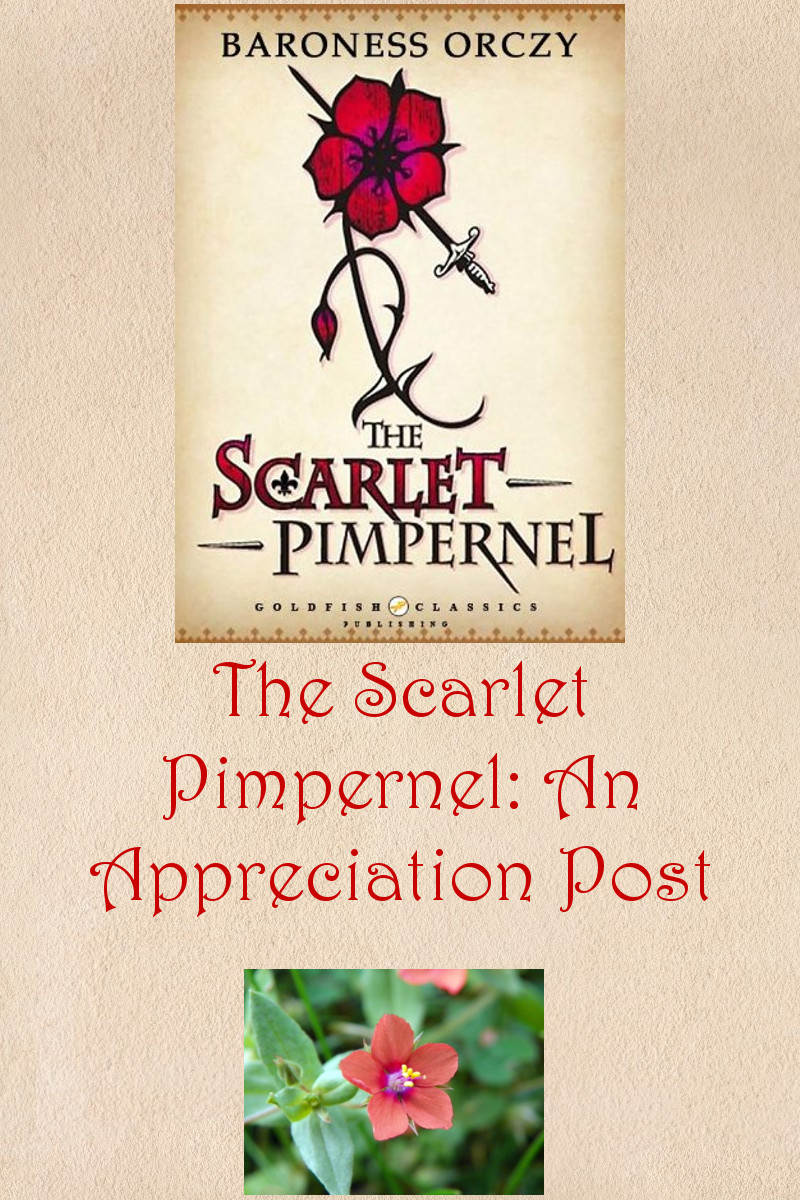
The Scarlet Pimpernel: An Appreciation Post


It's hard for me to describe how much I love this book.  It's one of the few 300+ page books I've read in one sitting.  The characters and the plot are so enthralling I just can't put it down...even after having read it so many times I've lost count!

I told my sister I wanted to do a blog post on The Scarlet Pimpernel, and she said, "Wait...the book or the movie?"  Apparently there are a lot of blog posts out there talking about how great the movie with Anthony Andrews, Jane Seymour, and Ian McKellen is, but very few talking about how great the book is.  So I decided to do a post about the book.  I do like the movie, and maybe sometime I'll do a blog post on that, but the book comes prior.

Where do I start?  I guess I'll start with the characters.

Warning: This post does contain spoilers.  If you haven't read the book, go read it.  Then you can come back and read this. ;)


The Scarlet Pimpernel

The Scarlet Pimpernel is a hero shrouded in mystery.  He has one goal: helping French royalists in danger of death to escape to England during the French Revolution.  He carries out his daring rescues in disguise; no one knows who he really is except his nineteen followers.  He's kind of the antithesis of the Phantom of the Opera.  (I can't stand the Phantom, but I'm not going to discuss that at length here.)  The Phantom is a mysterious figure who does awful things; the Scarlet Pimpernel is a mysterious figure who does great things.  The English and the French royalists love him; the French revolutionaries hate him.

As the story goes on, the reader begins to get hints about the Scarlet Pimpernel's identity.  Finally, Lady Marguerite Blakeney discovers the truth.  The mysterious man is the most unlikely man possible--Marguerite's husband, Sir Percy Blakeney, a man known in English society as a brainless dandy, or to put it bluntly, a fool.  Sir Percy's identity as the Scarlet Pimpernel is so important that he puts on the mask of a fool in his everyday life.  And I think that's one of the coolest things about him.

I don't know if Baroness Orczy was thinking of Shakespeare plays when she wrote the character of the Scarlet Pimpernel, but Sir Percy always makes me think of the Shakespearean fool.  Shakespeare's Fool is often the only character in the play who understands what's really going on.  The other characters think he's stupid, but he's actually wiser than they are.  Similarly, Sir Percy poses as someone who only cares about clothes and lame jokes.  This is the safest disguise of all, because who would suspect someone who seems so foolish to be the mastermind behind the escape of hundreds of French royalists?

Sir Percy is also a man deeply in love.  He practically worships the ground Marguerite walks on.  But because at the beginning of the story he can't trust her with his secret, he has to appear to her the way he appears to everyone else.  She thinks he's stupid and doesn't love her.   Wearing the mask of the fool even around Marguerite is breaking Sir Percy's heart.  It's so satisfying when Marguerite learns who Sir Percy really is, and still more satisfying when he learns he no longer has to conceal his identity or his love from her. 

Sir Percy is awesome.  He has enough bravery to walk right up to his worst enemy, clap him on the back, and tell him dumb jokes, all the while coming up with a new plan for outwitting him.  He risks his life again and again for the sake of the people depending on him.  And his schemes are at the same time incredibly clever and outrageously audacious.   He's basically the superhero of the resistance to the French Revolution.  I only wish he was real!


Marguerite Blakeney

 I didn't like Marguerite Blakeney at the beginning of the book.  I think that was the writer's intent.   Marguerite is portrayed as a woman who is blasé, sarcastic, and disappointed in life.  She has married Sir Percy Blakeney, a man violently in love with her, only to find his affection grow cold when he learned she was the cause of a French royalist family being sent to the guillotine.  She's too proud to tell Sir Percy that she made a horrible mistake and tried to save the family from death.  Although she's married to the richest man in England and has everything money can buy, Marguerite is miserable.  There's only one thing in her life that she really cares about: her brother Armand.  

So when she learns that Armand is in deadly danger and the only way she can save him is by betraying the Scarlet Pimpernel to the French revolutionaries, she is torn.  Although she has no idea who the Scarlet Pimpernel is, she has always admired him with something akin to hero-worship.  How can she send him to the guillotine?  On the other hand, how can she let Armand die without trying to save him?  Her love for her brother overcomes her sense of right and wrong.  She finds a clue that puts Chauvelin, the Scarlet Pimpernel's arch-nemesis, on his track.  

But then she finds a gold ring with the insignia of the Scarlet Pimpernel in her husband's study.  All kinds of clues come together in her mind and she realizes that her husband, the "brainless" Sir Percy, is actually the Scarlet Pimpernel!  Never before has Marguerite regretted anything so much as she regrets having put Chauvelin on the Scarlet Pimpernel's track.  So she races across country with a friend of her husband's, Sir Andrew Ffoulkes, to try to get to Sir Percy and warn him before Chauvelin finds him.  She must save her husband, even if it means losing her own life.  

Although Sir Percy is the hero of The Scarlet Pimpernel, Marguerite is its protagonist.  Sir Percy doesn't change throughout the story.  Marguerite does.  She has to learn truths about love and sacrifice.  She has to completely change her perception of the husband she thought she knew. 

Marguerite learns that love does not excuse betrayal.  The love for her brother Armand that led her to denounce a family of French royalists and betray the Scarlet Pimpernel was warped and selfish.  It has caused terrible harm to others.  Marguerite doesn't see this, though, until she learns that her own husband is in danger because of her love for her brother.  Then she sees that love doesn't make the end justify the means.  Betraying the Scarlet Pimpernel to save her brother was a crime that Marguerite spends the rest of the book trying to mend.  And she does this through offering her very life for Sir Percy's safety.  Marguerite may be a character that starts out with a lot of selfishness, but she ends up as a woman of love and courage. 


Chauvelin

Chauvelin is the perfect arch-nemesis for this story.  Clever, daring, and apparently heartless, he's the man the French revolutionaries have picked to hunt down the Scarlet Pimpernel.  All Chauvelin cares about is the success of the Revolution.  And he has an undying hatred for the man who has so boldly outwitted the Committee of Public Safety again and again.  He comes to England determined to find out who the Scarlet Pimpernel really is so he can follow him to France and capture him.

Chauvelin decides to recruit one woman to help him in his task: Marguerite Blakeney.  He knew her in France when she and her brothers were both supporters of the French Revolution.  He thinks he can get her to help him, with the proper persuasion.  Quickly Chauvelin finds a way to persuade Marguerite: he gets possession of a letter that proves Marguerite's brother Armand is really in league with the Scarlet Pimpernel.  He tells Marguerite that unless she helps him find out who the Scarlet Pimpernel is, her brother is going to die.  Heartless, clever man!  He treats life like a chess game.  He'll give Marguerite a pawn, her brother, if it means he'll be able to take the king, the Scarlet Pimpernel.  

I think Chauvelin is a well-done villain because he keeps the stakes of the story high.  Nothing will deter him from following his goal of capturing, torturing, and killing the man who has evaded him for so long.  He's also a well-done villain because he has a good understanding of human nature.  He uses Marguerite's emotions as tools in his despicable scheme.  But the Scarlet Pimpernel understands human nature better yet, as he eventually tricks Chauvelin through his understanding of Chauvelin's anti-Semitism.  Chauvelin never saw that one coming!


There are many other terrific characters in The Scarlet Pimpernel.  There are characters that almost feel like Dickens characters: Mr. Jellyband, Mr. Hempseed, and Mr. Jellyband's daughter Sally.  There's sweet little Suzanne, friend of Marguerite.  There's Sir Andrew Ffoulkes, the member of the League of the Scarlet Pimpernel who takes Marguerite to France to try to save her husband.  Baroness Orczy did a great job developing the other characters in a way that doesn't distract the reader from the main story.  

Apart from the characters of The Scarlet Pimpernel, the plot is just so good!  I love the way the reader doesn't learn who the Scarlet Pimpernel is until Marguerite figures it out.  The reader also doesn't learn how the Scarlet Pimpernel is going to defeat Chauvelin until after he's defeated him.  This makes the book wonderfully suspenseful.  The ending, with Sir Percy and Marguerite finally together again, is wonderful too.  I just love this book!


Thursday, February 1, 2018

Fan Fiction: Pros and Cons


I've always had mixed feelings about fan fiction.  Is it worth reading?  Is it even a legitimate genre of writing?   So I thought I'd explore a few pros and cons of fan fiction (both for readers and for writers) in this post.

Starting with the cons:

  • Because fan fiction is inherently derived from someone else's work, the authors are using ideas that are not their own.  Instead of coming up with characters and plots from scratch, they're using someone else's work as a springboard.  This can cause problems.  There's the obvious plagiarism issue: is the fan fiction author just ripping off somebody else's story?  Writers can get into dubiously moral and even illegal territory with fan fiction, especially if they're trying to get it published.
  • There is a lot of low-quality fan fiction out there.  A LOT of it.  Many people who attempt writing fan fiction know nothing about writing but want to invent further adventures for their favorite characters.  So the fan fiction they come up with is poorly written.  I'm sure this gives them writing practice, but it makes it frustrating to read fan fiction because there's so much poorly-done fan fiction to wade through. (To be fair, there are a lot of original books out there that are also very poorly written.  But it seems to be harder to separate the bad from the good in fan fiction than it is in in original fiction.  Maybe that's partially due to the fact that far fewer people have read the fan fiction than the original works, so there aren't many people to ask whether a particular work of fan fiction is good or not.)
  • A lot of fan fiction is highly innappropriate.   What is it with people wanting to take good stories and rewrite them with added sexual content?  That seems like a good idea? Really?  It frustrates me to find what seems like an interesting spinoff on Pride and Prejudice, only to find the author has given Mr. Darcy a backstory that's indistinguishable from Mr. Wickham's.
So there are the cons.  (I'm sure there are more...please comment below with any thoughts.)
Now how about a few pros?

  •  Famous ancient writers did it.  Shakespeare's Romeo and Juliet was inspired by a poem by Arthur Brooke called "The Tragical Historye of Romeus and Juliet."  Virgil's Aeneid is based on Homer's Iliad and The Odyssey.  It seems to me that most of the Robin Hood stories are fan fiction as well, since they're based off the old Robin Hood ballads or off each other.  Come to think of it, Sir Walter Scott's Ivanhoe is fan fiction.  These are books people are required to read in school!
  • Fan fiction satisfies a great longing in its authors.  Have you ever finished a book and been really sad that it was the last one in the series?  I have.  When I was six, I started writing a sequel to C.S. Lewis's The Chronicles of Narnia because I couldn't stand that there weren't any more Narnia books(Actually, it wasn't technically a sequel since it happened between Prince Caspian and The Dawn Treader.  I believe they call that a paraquel.)  
  • Fan fiction is also a good way to practice general writing skills.  Some people that might not otherwise have started writing fiction began with fan fiction.  I think that's a good thing!
  • Well-done fan fiction can be a lot of fun to read.  I read a sequel to Frances Hodgson Burnett's A Little Princess called Wishing For Tomorrow.  It continues the story of the girls who are in the school after Sara leaves in a really satisfying way.  
In summary:  It seems to me that fan fiction is a double-edged sword.  It can be done well; if it's based on classics or other old sources where stealing intellectual property is not an issue, gives credit to the original work where credit is due, and has good content and good writing style, I think it's a worthy addition to the world's literature.  If it's done badly...it deserves to be flung into the depths of Mount Doom. :P

What do you think about fan fiction?  I'd love to hear your thoughts in the comments!

(Full disclosure: I am at this time writing fan fiction myself.  I'm writing a novel based on Pride and Prejudice set in Colorado in the 1870's.  Whether this will ever become a worthy addition to the world's literature remains to be seen.)

Thursday, January 18, 2018

My Favorite Fictional Detectives


I've always loved detective stories.  As a child, I read every "Happy Hollisters," "Hardy Boys," and "Nancy Drew" book I could get my hands on.  I always tried to figure out the mystery before the end of the book.  Sometimes I was successful, but most of the time I was completely mystified until the detective revealed the truth.  Then (finally) I was old enough to read classic mystery stories written for adults.  I devoured stacks of mystery books and discovered three detectives that became favorites (and remain favorites to this day): Father Brown, Lord Peter Wimsey, and Miss Marple.

Note: In the selection of those three detectives as my favorites, I have no ill-will towards Sherlock Holmes or Hercule Poirot.  I have also read and enjoyed books featuring those detectives (and spent considerable time researching to figure out how to say Poirot's name...it's pronounced "air-KYOOL pwa-ROH").  


Father Brown

“But, as a matter of fact, another part of my trade, too, made me sure you weren’t a priest.” “What?” asked the thief, almost gaping. “You attacked reason,” said Father Brown. “It’s bad theology.” 
(G.K. Chesterton, The Blue Cross)

 Father Brown is, first and foremost, a Catholic priest with a firm grasp of theology and a great zeal for the conversion of sinners.  But he's also an expert at solving mysterious crimes.  From his dealings with vast numbers of people in various states of sin and repentance, Father Brown has learned a lot about human nature.  His secret to solving crimes is that he can put himself in the criminal's shoes; he knows just what he would do if he were the man stealing the diamonds.  And he's not as interested in bringing criminals to justice as he is in getting them to see where they've done wrong. 
 
Father Brown also has a sense of humor.  For instance, in The Blue Cross, he leaves a trail of ridiculous things behind him for the French detective Valentin to follow...mixing up apples and oranges, putting salt in a sugar bowl, and paying for a windowpane first and breaking it afterwards!

Father Brown is incredibly humble and innocent.  He will capture a criminal and then slip away before anyone gets a chance to thank him.  The criminals that he confronts don't know what to make of him; he's nothing like any detective they've ever seen.  One of them, Flambeau, repents after he's caught and becomes fast friends with Father Brown, helping him solve more crimes.

G.K. Chesterton did a marvelous job with Father Brown's character!  The only thing I'm sad about is that I've read all the Father Brown stories...I wish there were more!


Lord Peter Wimsey

“But to Lord Peter the world presented itself as an entertaining labyrinth of side-issues.”
(Dorothy L. Sayers, Clouds of Witness)

British aristocrat.  Bibliophile.  Master of Arts from Oxford.  John Donne enthusiast.  Champion cricket player.  Expert pianist.  Crime solver.  Lord Peter Wimsey is the Renaissance man of detectives.  Everything interests him, and no detail is too small for him to notice.  With his butler, Bunter (a man much like P.G. Wodehouse's Jeeves), he continually finds himself getting involved in detective cases.  Those around him say indulgently that it's a hobby he has.  Lord Peter knows better...he doesn't solve crimes because he likes to.  He solves crimes because he knows how to do it and people ask him to help them.  

Lord Peter is a human character, despite his nearly superhuman powers of observation.  He has difficulties with his brother and sister-in-law, who don't like his detective work.  He has nervous breakdowns caused by PTSD from World War I.  He is madly in love with Harriet Vane, whom he saved from the gallows and who continually maintains she will never marry him. (He proposes to her at intervals...on April Fool's Day, on her birthday, or in the middle of a group of police...sometimes very seriously, sometimes jocosely.) 

Lord Peter is also full of quotations.  In Have His Carcase, he says, "I always have a quotation for everything--it saves original thinking."  I always love it when book characters quote other books I've read!  He talked so much about Kai Lung and about John Donne's poetry that I went and checked out both books from the library.  (I was not disappointed.)  

Some say that Dorothy Sayers must have been in love with the character of Lord Peter Wimsey while she was writing those books.  I believe it!  His character is incredibly well-done.


Miss Marple

“Miss Marple is a white-haired old lady with a gentle appealing manner- Miss Wetherby is a mixture of vinegar and gush. Of the two Miss Marple is the more dangerous.”  
(Agatha Christie, Murder at the Vicarage)

No one who didn't know Miss Marple would ever think she had anything to do with solving crimes.  She's an elderly lady with a meek, kindly attitude and a propensity for listening to village gossip.  And she's lived in the same village for almost all of her long life.  But she has an uncanny knack for spotting a criminal.

Miss Marple's secret lies in her knowledge of the people in her own village.  According to her, “Everybody is very much alike, really. But fortunately, perhaps, they don't realise it." When a crime is committed, Miss Marple can remember a similar situation from when she was young.  By remembering the sort of person who committed the similar crime long ago, she can figure out who must have committed this crime.  

She doesn't stay at home trying to solve crimes, either.  She travels around, poking her nose into all kinds of situations to find out what's going on.  People tell her things because they don't have any idea she's doing detective work.  Sometimes her work is dangerous and she has to flee, but she remains determined to figure out the truth.  She has more bravery and perseverance than someone a quarter of her age.  And through it all, she stays sweet and kind.  Agatha Christie invented a fantastic character in Miss Marple!


Thursday, January 11, 2018

Five Incredible Books that Deserve to be Read


Have you ever been in this situation?  You read a book and want to discuss it with somebody.  Then you discover that none of your friends (or hardly any of them) have read it...so you go around trying to get them to read it!  This post is my attempt to do just that. :D  Here are short summaries of five books that I really like and think others would like to read too!


The Paradise Project by Suzie Andres


The Paradise Project is a Pride and Prejudice-esque novel set in the modern day.  It's really fun as a Jane Austen spinoff, but I know I would have loved it even if I had never read any Austen at all.  The characters are vivid; the plot is well-done; and the humor is terrific!  The main character, Elizabeth Benning, embarks upon a year-long project to find happiness.  With support from her loving sister Jane and best friend Emily, competition from Jane's husband Pat, well-meaning interference from a mysterious man named Ralph, and chilly behavior from Ralph's friend (or is it girlfriend?) Gretchen, Elizabeth has her work cut out for her to find where her happiness lies!

This book is extra-special to me because I know the author, Mrs. Andres, personally.  If you want to learn more about her writing, you can visit her website: http://www.suzieandres.com/ !


Enemy Brothers by Constance Savery


I read Enemy Brothers first in high school and enjoyed it immensely.  In fact, I liked it so much that when I had to write an essay on a book for my college application, I chose it for the subject of my essay.  Enemy Brothers is the story of two brothers caught on opposite sides of World War II.  Twelve-year old "Max Eckermann" is taken away from Germany and brought to England.  When he gets there, he runs into a young Englishman named Dym who says Max is really his kidnapped younger brother Tony.  Max--or Tony--is determined to get back to Germany and help Hitler win the war; Dym is equally determined to show him that he's really his brother and that England's cause is right.  The characters, especially those of Dym and Tony, are fantastic.  I've re-read this book at least half a dozen times, and every time I enjoy it just as much as the time before.


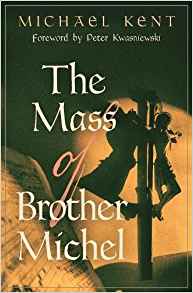
The Mass of Brother Michel by Michael Kent


I borrowed this book from a college friend and absolutely loved it!  For years it was out of print, and I tried to get it used but despaired when I saw how much money it was going to cost.  Finally, however, it's back in print!  
The Mass of Brother Michel tells the story of a young nobleman in the Middle Ages.  At the beginning, he seems to have all the good things in life: health, good looks, riches, and a beautiful and good lady in love with him.  But when he gets seriously injured in a hunting accident, his whole life turns around as evil family members turn against him.  Michel ends up in a monastery, offering all his sufferings up to God.  In his new life, his one desire is to become a priest and be able to offer Holy Mass...but he needs to learn that sometimes even the holiest of desires is unattainable on earth.  This book explores the depths of human misery and suffering and the joy of holiness; it's one of the most moving books I've ever read.  I highly recommend it.


Where The Woods Grow Wild by Nate Philbrick


It's hard for me to find a fantasy novel that I like.  If it isn't by C.S. Lewis or J.R.R. Tolkien I have an inherent distrust of it.  Other fantasy novels usually seem to be 1) not very good or 2) totally copied from Lewis and Tolkien.   But I stumbled upon this fantasy novel, Where the Woods Grow Wild, a few months ago, and I loved it.  It's a new book...it just came out in December 2016!

Where The Woods Grow Wild is the story of a boy named Martin who goes into the forest to search for his missing friend Elodie.  This forest isn't like any other forest I've read about, and the creatures in it aren't like any creatures I've read about, either.  The author, Nate Philbrick, did a fantastic job at building his own fantasy world.  The characters are complex and well-rounded.  Also, the book is very clean (which I really appreciate).  A lot of the things Martin finds in the forest are downright terrifying, so that I was on the edge of my seat with suspense.  This was a very fun, exciting book!

The author (who's only in his twenties, by the way) has a blog at https://youwritefiction.wordpress.com/ where he gives terrific (and funny) writing advice and talks about the other writing projects he's working on (including a sequel called Where The Woods Grow in Flames).


Carney's House Party by Maud Hart Lovelace


Last but not least, Carney's House Party is a book about a girl living in a town called Deep Valley, Minnesota right before World War I.  It has many of the characters from Maud Hart Lovelace's "Betsy-Tacy" books, but it's not necessary to have read the "Betsy-Tacy" books to enjoy this one!  Caroline, or "Carney," is home from college for the summer and navigating relationships with her friends.  With Larry (her old beau) coming back from California, Isobel (her sophisticated, sometimes stuck-up, college roommate) staying with her, Sam (a dashing young neighbor that Carney can't understand) hanging around for reasons of his own, and a community spreading gossip like wildfire, Carney is in for an unforgettable summer!